




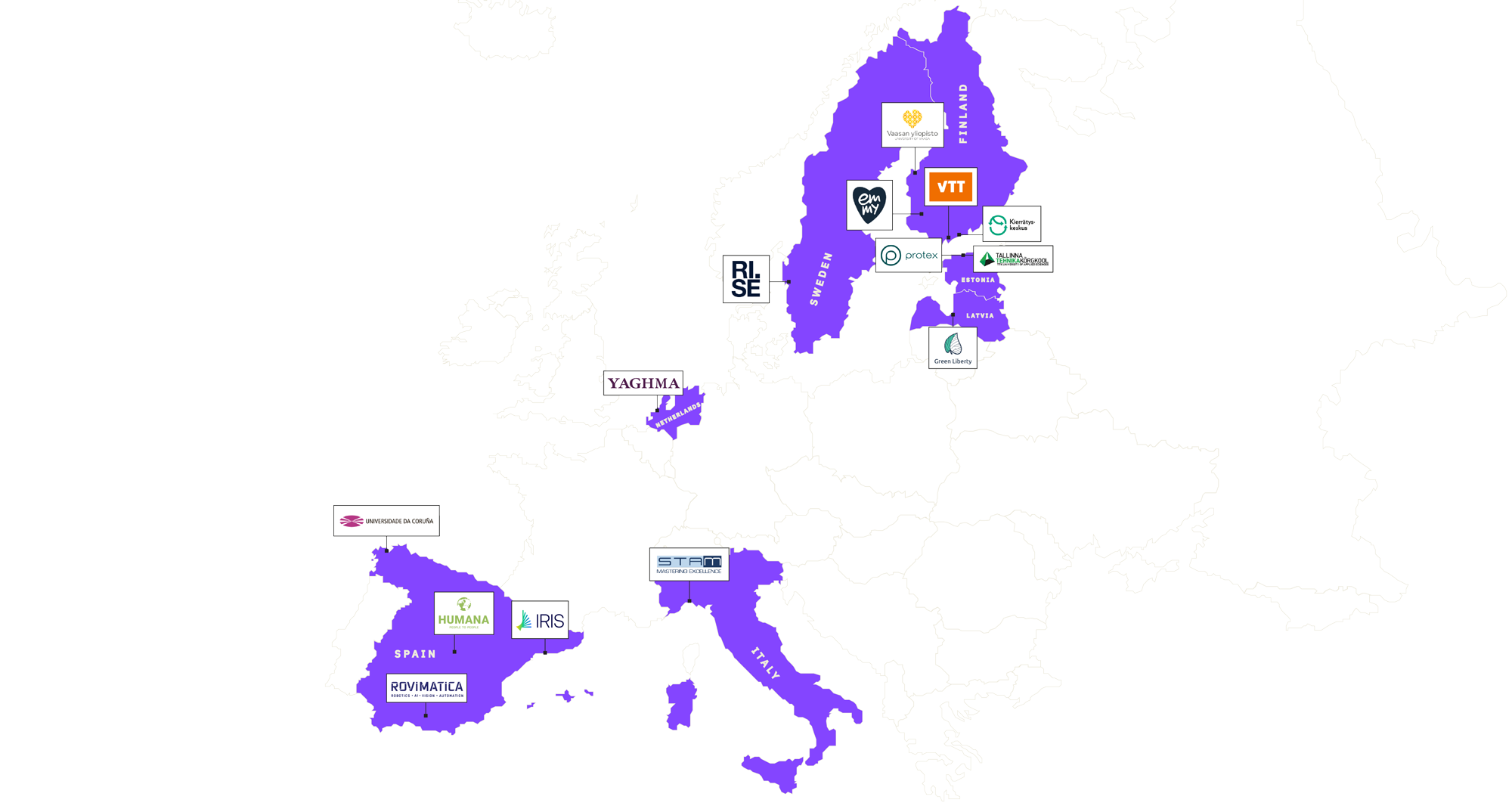

VTT Technical Research Centre of Finland not only leads the project but also brings expertise in smart tags and their integration, the development of data platforms and DPP requirements, and sustainability assessments.

Helsinki Metropolitan Area Reuse Centre (Finland) engages in end-user studies and conducts the demonstration of the TexMat solution.
HUMANA Fundación Pueblo para Pueblo (Spain) participates in business model validation and end-user studies, and leads the demonstration of the TexMat solution.

Green Liberty (Latvia) contributes to EPR policy and circular solutions, and leads the work on communication, dissemination and exploitation.

IRIS Technology Solutions (Spain) develops digital and software solutions for textile collection and sorting, and supports integration with the TexMat digital platform.

Research Institutes of Sweden conducts sustainability assessments and leads the work on EPR policies.

EMMY Clothing Company (Finland) contributes to end-user studies and SME perspectives for business model validation, participates in the TexMat demonstration, and supports consumer and stakeholder engagement.

University of Vaasa (Finland) leads the development of business models for the circular textile economy, including consumer studies to inform end-user engagement strategies.

Protex Balti (Estonia) brings industrial knowledge in textile materials and production, collaborating on DPP integration and ensuring solutions are practical for different types of garments used in the TexMat demonstration.

TTK University of Applied Sciences (Estonia) provides expertise in textile materials and garment manufacturing, contributing to the development of scalable and durable DPP integration processes.

Rovimatica (Spain) develops the TexMat App and the TexMat smart container, and provides expertise in software development and artificial intelligence in the development of TexMat digital platform.

YAGHMA (Netherlands) is involved in developing the TexMat digital tools including public perception radar and policy tracker tool.

STAM (Italy) contributes expertise in the design and integration of robotics and automation systems, including hyperspectral analysis, the design and development of the TexMat smart container, and to the automated sorting-for-reuse system.

University of A Coruña (Spain) collaborates on business model development, consumer studies, and system requirements, and also contributes to environmental assessments.